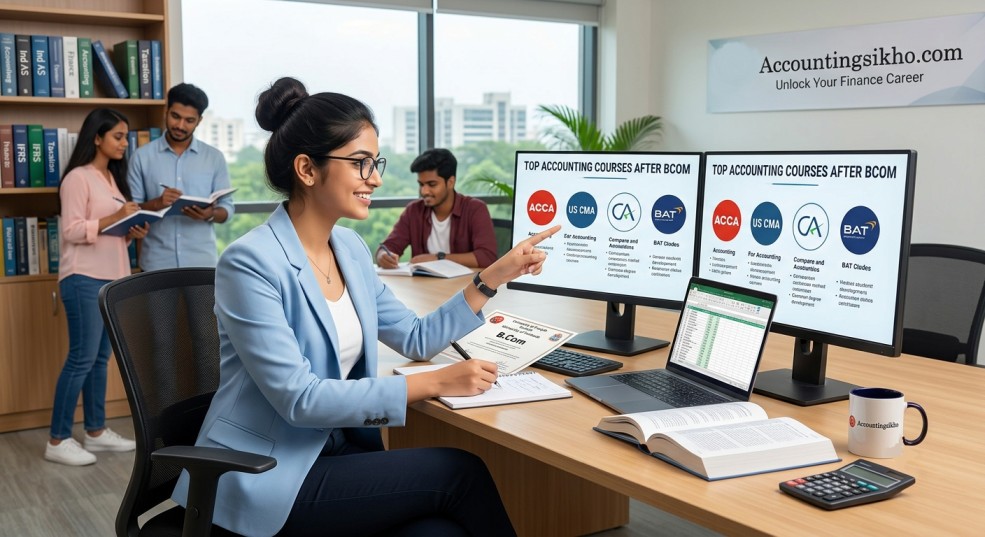
Selecting the right accounting course after bcom is the most critical decision for commerce graduates aiming to build a high-paying, future-ready career in finance. While a Bachelor of Commerce degree lays the foundation of double-entry bookkeeping and accounting principles, modern employers demand practical software expertise, advanced taxation skills, and globally recognized certifications.
Whether your goal is to land a entry-level job as a tax practitioner or step into global corporate finance at a Big 4 firm, choosing an industry-aligned post-graduation credential makes all the difference. At Accountingsikho, we empower commerce students with practical learning roadmaps, real-world software modules, and professional insights. This guide breaks down the top options for an accounting course after bcom, detailing course fees, program duration, job roles, and potential salaries in 2026.
Why Enroll in an Accounting Course After BCom?
Graduating with a B.Com degree gives you an understanding of basic commerce subjects, but the modern corporate job market requires job-ready technical specialization. Companies no longer want candidates who only know manual ledger maintenance; they need professionals trained in cloud accounting software, statutory tax filings (GST & TDS), and international reporting standards like IFRS.
┌─────────────────────────────────────────────────────────────────────────────┐
│                          Career Evolution Path                              │
├───────────────────────────────┬─────────────────────────────────────────────┤
│ B.Com Graduate                │ Skilled Accounting Professional             │
│ • Basic Theoretical Knowledge │ • Hands-on Tally Prime & Advanced Excel     │
│ • Manual Journal Entries      │ • Live GST, TDS, & Income Tax Filing        │
│ • General Ledger Concepts     │ • Strategic Financial Analysis & Compliance │
└───────────────────────────────┴─────────────────────────────────────────────┘
Enrolling in a specialized accounting course after bcom bridges the gap between academic theory and practical corporate demand. It enhances your resume, increases your starting salary package by 50% to 100%, and opens career pathways across multinationals and tax advisory firms.
Top Specialized Pathways for an Accounting Course After BCom
Depending on your career goals, budget, and time investment, several professional certifications and job-oriented diplomas stand out in 2026. Below is a detailed evaluation of top-tier courses available after your graduation:
1. Certified Business Accounting and Taxation (BAT) / Practical Taxation Course
Overview: A practical, fast-track training program tailored specifically for commerce graduates who want to start working within 3 to 6 months. It focuses on Tally Prime, SAP FICO modules, Advanced Excel, payroll processing, and live GST/TDS return filing on government portals.
Duration: 3 to 6 Months
Average Salary: ₹3.5 LPA – ₹6.0 LPA
Best For: Freshers looking for quick entry into corporate accounting without dedicating multiple years to long professional exams.
2. Association of Chartered Certified Accountants (ACCA – UK)
Overview: ACCA is an international professional body offering a global accounting qualification recognized in over 180 countries. It covers IFRS, global audit, performance management, and international taxation.
B.Com Advantage: B.Com graduates typically receive exemptions for up to 4 paper exams (out of 13), allowing them to fast-track their completion.
Duration: 2 to 3 Years
Average Salary: ₹6.0 LPA – ₹11.0 LPA
Best For: Candidates aiming for roles in MNCs, Big 4 audit firms, or overseas career opportunities.
3. US Certified Management Accountant (US CMA)
Overview: Administered by the Institute of Management Accountants (IMA), US CMA is a globally recognized credential focusing on cost management, corporate governance, budgeting, and financial strategy.
Structure: Consists of just 2 comprehensive exam parts, making it an achievable milestone for B.Com graduates.
Duration: 6 to 9 Months
Average Salary: ₹5.5 LPA – ₹9.5 LPA
Best For: Students interested in management accounting, financial analysis, and strategic corporate planning.
4. Chartered Accountancy (CA – Direct Entry Route)
Overview: Regulated by the Institute of Chartered Accountants of India (ICAI), CA remains the most prestigious Indian credential for auditing, taxation, and corporate law.
B.Com Advantage: Graduates with 55%+ marks can skip the CA Foundation exam entirely via Direct Entry and jump straight into CA Intermediate.
Duration: 3 to 4 Years (includes a mandatory 2-year practical articleship)
Average Salary: ₹8.0 LPA – ₹15.0 LPA
Best For: Students aiming for audit practice, tax consulting, or high-level corporate CFO tracks.
Course Comparison Matrix for B.Com Graduates
| Course Name | Recognition | Duration | Industry Focus | Skill Highlight |
| BAT / Practical Taxation | National | 3–6 Months | SME & Indian Corporate | Tally Prime, GST, TDS, E-Way Bill |
| US CMA | Global | 6–9 Months | Corporate Finance & Strategy | Financial Analysis, Cost Control |
| ACCA (UK) | Global (180+ countries) | 2–3 Years | Global Accounting & MNCs | IFRS, Global Taxation, Audit |
| CA (ICAI) | National & Regional | 3–4 Years | Statutory Audit & Tax Advisory | Indian Tax Laws, Companies Act |
| SAP FICO Module | Global Enterprise | 3–4 Months | Large Enterprise ERP | Enterprise Resource Planning |
How to Choose the Right Accounting Course After BCom
Selecting the ideal training program on Accounting sikho depends on evaluating three main parameters:
┌─────────────────────────┐     ┌─────────────────────────┐     ┌─────────────────────────┐
│     Career Target       │     │    Time Commitment      │     │    Budget & Fees        │
├─────────────────────────┤     ├─────────────────────────┤     ├─────────────────────────┤
│ • Domestic tax job      │     │ • Short-term (3-6 mo)   │     │ • Budget-friendly       │
│ • MNC audit role        │     │ • Mid-term (1-2 yrs)    │     │ • Premium certification │
│ • Practice/Consulting   │     │ • Long-term (3-4 yrs)   │     │ • Installment options   │
└────────────┬────────────┘     └────────────┬────────────┘     └────────────┬────────────┘
             │                               │                               │
             └───────────────────────┬───────┴───────────────────────────────┘
                                     ▼
                      ┌─────────────────────────────┐
                      │ Optimized Learning Pathway  │
                      └─────────────────────────────┘
Target Working Sector: If you want to work locally or start earning immediately, choose a short-term practical taxation and Tally course. If your ambition is to join multinational corporate firms, prioritize global certifications like ACCA or US CMA.
Time Availability: Decide whether you can dedicate 3+ years to rigorous exam preparation or need a job-ready diploma within a few months.
Software Competency: Modern accounting is digital. Ensure the course you choose provides hands-on practice with tools like Tally Prime, Zoho Books, Microsoft Excel, and SAP.
Roadmap: Moving from Learning to Placement with Accountingsikho
Roadmap: Moving from Learning to Placement with Accountingsikho
Identify your career goals and interests
Evaluate whether you lean toward quantitative analysis, corporate tax compliance, or auditing. Choose a course profile matching your natural strengths.
Master tools used in real accounting offices
Learn double-entry ledger creation, bank reconciliation, GST return filing, and Advanced Excel formulas to build job-ready practical skills.
Gain hands-on experience before interviews
Execute simulated tax filings, process mock corporate payrolls, and build financial balance sheets to create a proof-of-work portfolio.
Land interviews with targeted recruiters
Tailor your resume around relevant tools (e.g., Tally, SAP, Excel), highlight certifications, and practice interview questions on Accountingsikho to secure your ideal offer.
Frequently Asked Questions (FAQs)
Which is the best short-term accounting course after bcom for freshers?
For freshers seeking fast-track employment, a Business Accounting and Taxation (BAT) or a Practical Tally Prime with GST course is ideal. These courses can be completed in 3 to 6 months and focus on live compliance skills that recruiters immediately demand.
Can I get exemptions in global courses after completing B.Com?
Yes, international accounting qualifications like ACCA offer exemptions to B.Com graduates for up to 4 foundational exam papers. This reduces the overall course duration and exam costs significantly.
Is pursuing an accounting course after bcom necessary to get a job?
While you can find entry-level jobs with a plain B.Com degree, salaries are often lower and growth can be slow. Enrolling in a targeted accounting course after bcom equips you with practical software skills like Tally, Excel, and SAP FICO, allowing you to secure higher starting packages and faster promotions.
What software skills should be included in an accounting course after bcom?
An industry-aligned course should cover Tally Prime, Microsoft Excel (Advanced), Zoho Books, SAP FICO, and direct hands-on practice on official GST and Income Tax filing portals.