
Completing a Bachelor of Commerce (B.Com) degree gives you a solid foundation in business and finance, but entering today’s job market requires specialized skills. A general undergraduate degree alone rarely guarantees high-paying roles in multinational corporations or top accounting firms. Choosing the best accounting course after bcom bridges the gap between academic theory and real-world execution, equipping you with practical expertise in taxation, auditing, financial modeling, and corporate accounting.
At Accounting sikho, we mentor thousands of Commerce graduates to turn their basic degrees into lucrative careers. Whether you aim to land a role as a certified public accountant, tax consultant, or financial analyst, selecting the right post-graduation program is the single most critical decision for your career trajectory.
Why Enrolling in an Accounting Course After BCom is Essential
Graduating with a B.Com degree demonstrates your understanding of debits, credits, and general ledgers. However, modern employers demand hands-on expertise in automated accounting software, international financial reporting standards, and advanced tax laws.
Here is why pursuing a professional accounting certification or diploma after your B.Com is necessary:
Higher Starting Salaries: Specialized certifications can double or triple your entry-level salary compared to a standard B.Com graduate.
Global Mobility: Internationally recognized credentials allow you to practice in countries like the US, UK, Canada, and the UAE.
Practical Software Mastery: Professional programs train you on tools like Tally Prime, SAP FICO, QuickBooks, and Advanced Excel.
Faster Career Progression: Specialized skills position you for management roles, such as Senior Accountant, Financial Controller, or Audit Manager, much faster.
Top Professional Courses to Pursue After BCom
Selecting the right program depends on whether you want to work locally, clear international certifications, or master practical Indian accounting and taxation laws. Below is a detailed breakdown of the top options available.
1. Chartered Certified Accountant (ACCA – UK)
ACCA is a globally recognized professional body based in the UK. It covers financial management, reporting, taxation, and auditing across more than 180 countries.
Duration: 1 to 3 years.
Exemptions: B.Com graduates often receive exemptions for up to 4 papers out of 13.
Best For: Students seeking international career opportunities in MNCs and Big 4 firms.
2. Certified Public Accountant (US CPA)
Administered by the AICPA, the US CPA designation is the gold standard in global accounting. It is equivalent to the Indian CA credential but focused on US GAAP and US tax laws.
Duration: 12 to 18 months.
Structure: 4 core exam sections (FAR, AUD, REG, plus one discipline).
Best For: Graduates aiming for high-paying roles in US-based MNCs, global capability centers (GCCs), and audit giants.
3. Certified Management Accountant (US CMA)
If your interest lies in corporate finance, budgeting, and strategic management rather than pure auditing, the US CMA offered by the IMA is an excellent path.
Duration: 6 to 9 months.
Structure: 2 exam parts covering Financial Planning, Analytics, and Strategic Financial Management.
Best For: Careers in management accounting, corporate finance, and strategic planning.
4. Post Graduate Diploma in Practical Accounting & Taxation
For students who want immediate job placement without committing to multi-year global exams, practical short-term certifications offer direct training in Indian statutory compliance.
Focus Areas: Tally Prime, GST filing, Income Tax returns, TDS/TCS, e-way bills, and payroll processing.
Duration: 3 to 6 months.
Best For: Quick entry into small and medium enterprises (SMEs) or starting your own accounting consultancy.
Comparative Breakdown: Finding Your Ideal Accounting Program
To help you evaluate your choices easily, here is a comparative overview of the most popular professional credentials:
| Course Name | Global Recognition | Average Duration | Key Focus Area | Target Job Roles |
| US CPA | High (Global) | 12–18 Months | US GAAP, US Tax, Auditing | Audit Senior, US Tax Consultant |
| ACCA | High (Global) | 1–2.5 Years | IFRS, Global Audit, Financial Strategy | Financial Accountant, Global Auditor |
| US CMA | High (Global) | 6–12 Months | Costing, Financial Analysis, Strategy | Financial Analyst, Cost Controller |
| Practical Taxation & GST | Regional (India) | 3–6 Months | GST Returns, Tally, Income Tax Filing | Tax Executive, Senior Accountant |
How to Select the Right Program Based on Your Career Goals
Choosing the ideal path requires evaluating four key parameters:
Career Location: If you plan to work in India for Indian companies, master local tax laws, GST, and Tally. If you want to work for multinational companies or abroad, opt for CPA, ACCA, or CMA.
Time Investment: Long-term professional exams require 1000+ hours of rigorous study. If you need a job immediately, a practical 3-to-6-month diploma is a better stepping stone.
Budget: International courses have higher registration, exam, and tuition fees. Factor in the return on investment (ROI) before enrolling.
Learning Support: Self-study can be challenging for complex tax and auditing regulations. Enrolling in structured courses with expert mentorship at Accountingsikho.com ensures you grasp real-world applications alongside theory.
Essential Skills You Master in an Advanced Accounting Program
Completing a specialized accounting qualification equips you with both technical and analytical capabilities:
                  ┌──────────────────────────────────────────┐
                  │  Advanced Accounting & Finance Skillset  │
                  └────────────────────┬─────────────────────┘
                                       │
        ┌──────────────────────────────┼──────────────────────────────┐
        ▼                              ▼                              ▼
┌───────────────┐              ┌───────────────┐              ┌───────────────┐
│ Technical     │              │ Software      │              │ Strategic     │
│ Compliance    │              │ Proficiency   │              │ Analysis      │
├───────────────┤              ├───────────────┤              ├───────────────┤
│ • GST Filing  │              │ • Tally Prime │              │ • Financial   │
│ • Income Tax  │              │ • SAP FICO    │              │   Modeling    │
│ • US GAAP /   │              │ • Advanced    │              │ • Budgeting & │
│   IFRS        │              │   Excel       │              │   Forecasting │
└───────────────┘              └───────────────┘              └───────────────┘
Technical Compliance: Understanding how to calculate and file Goods and Services Tax (GST), Income Tax Returns (ITR), Tax Deducted at Source (TDS), and aligning financial statements with Ind AS or IFRS.
Software Proficiency: Operating industry-standard accounting tools like Tally Prime, SAP FICO, QuickBooks, and mastering Advanced Excel formulas (VLOOKUP, XLOOKUP, Pivot Tables, and macros).
Strategic Financial Analysis: Learning to read balance sheets, evaluate cash flow statements, perform variance analysis, and prepare financial models for business decision-making.
Step-by-Step Roadmap to Launch Your Accounting Career
To transition smoothly from a B.Com graduate to a hired professional, follow this structured roadmap:
Assess Your Strengths: Decide whether your interest lies in core accounting, taxation, auditing, or management consulting.
Select the Best Accounting Course After BCom: Match your timeline, budget, and career intent with the certifications detailed above.
Gain Hands-On Software Skills: Practice real-world case studies involving actual invoices, tax portals, and ledger reconciliations.
Build a Practical Portfolio: Document the financial reports, tax returns, or Excel models you create during your training.
Prepare for Technical Interviews: Practice domain-specific questions on debit/credit fundamentals, GST regulations, and financial statement adjustments.
At Accounting sikho , our industry-oriented training programs combine theoretical concepts with live project experience, giving you the confidence to excel in technical job interviews.
Frequently Asked Questions (FAQ)
Which course is best after B.Com for a high salary?
For high-paying global opportunities, US CPA and ACCA offer the highest starting packages, especially in Big 4 accounting firms and MNCs. If you prefer corporate strategy and management, US CMA is an ideal high-paying choice.
Can I do an accounting course after B.Com while working a full-time job?
Yes, most professional accounting courses like US CPA, US CMA, and diploma programs offer flexible online classes and part-time study schedules. This allows working professionals to upgrade their skills without pausing their current careers.
What is the duration of a practical accounting course after B.Com?
Short-term practical courses in accounting, GST, and Tally usually take between 3 to 6 months. International certification programs such as US CMA take around 6 to 12 months, while US CPA and ACCA take 1 to 2.5 years.
How does Accountingsikho.com help B.Com graduates?
Accounting sikho provides comprehensive, practical training modules covering core accounting principles, GST, Income Tax, Tally Prime, and Advanced Excel. Our expert mentors guide you step-by-step through real-world case studies to ensure you are job-ready from day one.
Conclusion
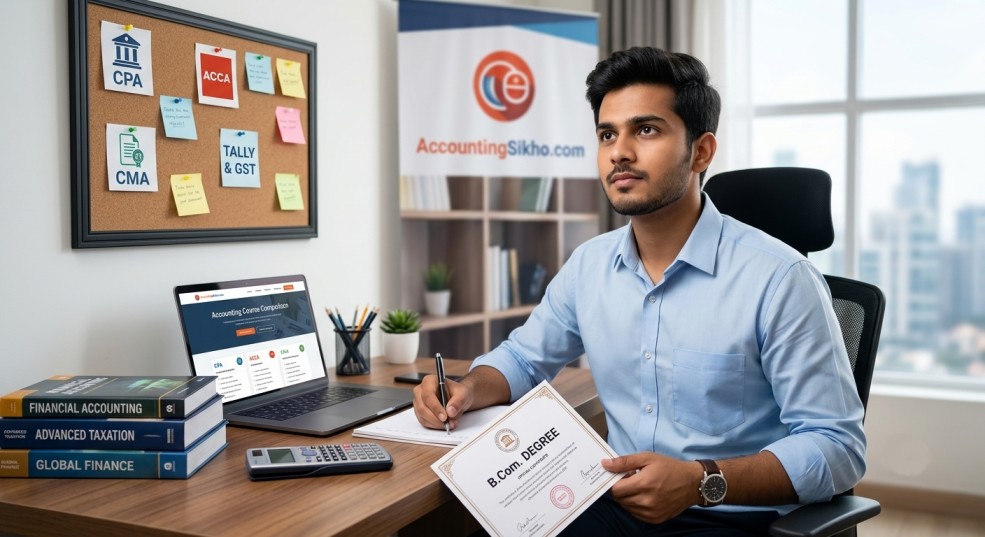
A B.Com degree is your entry ticket into the business world, but specializing through the best accounting course after bcom is what drives rapid career growth. Whether you choose international credentials like CPA and ACCA or prefer mastering local practical taxation and software tools, taking proactive steps today sets you apart in a competitive job market.
Explore our industry-focused learning tracks at Accounting sikho to master practical accounting, clear your professional exams, and secure your dream job with confidence!