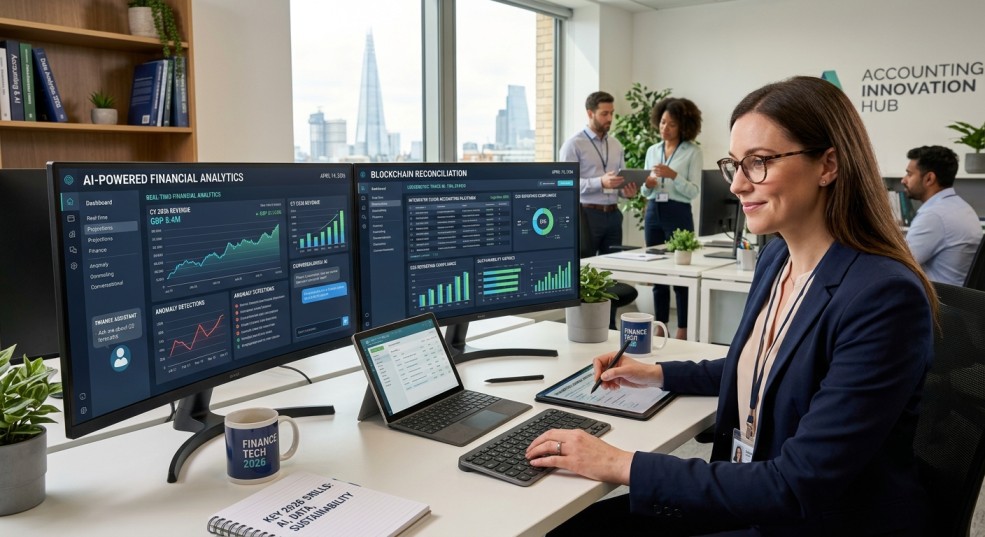
The accounting landscape has shifted fundamentally. Manual ledger entries, paper-based invoice tracking, and routine spreadsheet entry are no longer the focal point of a successful finance career. In 2026, artificial intelligence, continuous cloud auditing, real-time data pipelines, and evolving ESG reporting standards have redefined what employers expect.
To build a lucrative, future-proof career, learning core accounting skills in 2026 requires mastering a blend of fundamental accounting principles, digital technology, and strategic business advice. At Accounting Sikho, our training ecosystem is engineered around these dynamic industry requirements, ensuring candidates step confidently into modern finance roles.
The Transformation: Why Technical Skills Shifted in 2026
Automated systems now process millions of journal entries in seconds, auto-reconcile bank statements, and detect payment anomalies instantly. Because repetitive data tasks are handled by software, the value of an accountant has migrated from data gathering to data interpretation, system auditing, and strategic counsel.
Organizations today look for professionals who do not just record what happened, but explain why it happened and how to optimize future financial performance.
7 Crucial Accounting Skills in 2026
1. AI Literacy & System Integration
Understanding how to work alongside automated accounting software and generative AI agents is a baseline expectation. Modern accountants must know how to:
- Set up automated OCR (Optical Character Recognition) workflows for invoice ingestion.
- Audit AI-generated journal entries and spot algorithmic misclassifications.
- Use smart prompt engineering to summarize complex regulatory documents and draft executive variance briefs.
2. Advanced Cloud ERP & Software Mastery
Desktop-bound ledger systems are largely obsolete. High-demand professionals demonstrate deep hands-on expertise in cloud platforms such as Tally Prime, Zoho Books, QuickBooks Online, and SAP FI. This includes configuring multi-currency feeds, automated bank rules, and API connections between point-of-sale systems and general ledgers.
3. Data Analytics & Visual Storytelling
Numbers without context carry little value for enterprise executives. Candidates developing accounting skills in 2026 must master data visualization platforms like Power BI and advanced MS Excel (Power Query, dynamic arrays, and XLOOKUP). Transforming raw general ledgers into dynamic, executive-ready dashboards is now a core requirement.
4. Statutory Compliance & Tax Technology
Taxation is no longer just a legal and accounting discipline; it has become a data engineering function. Accounting professionals must manage automated tax portals, handle real-time e-invoicing reconciliations, manage GST input tax credit (ITC) matching, and maintain complete audit trails for regulatory compliance.
5. Financial Modeling & Predictive Forecasting
Historical financial reporting is now table stakes; modern leadership demands forward-looking insights. Skilled accountants build dynamic financial models to simulate cash flow scenarios, evaluate capital investments, and assess market risks under fluctuating economic conditions.
6. ESG & Sustainability Reporting Integration
Driven by international reporting standards (such as ISSB and local corporate disclosure mandates), non-financial reporting has joined the core accounting domain. Modern accountants are increasingly called upon to measure, audit, and report Environmental, Social, and Governance (ESG) metrics alongside traditional financial balance sheets.
7. Strategic Business Communication & Advisory
As AI manages computational speed, human connection and clear communication have become premium services. Translating complex financial data into plain language, offering strategic tax-saving advice, and building trusted advisory relationships with business owners are critical differentiators.
2026 Skill Requirements Comparison
Traditional Accounting Approach | Modern 2026 Accounting Approach |
Manual data entry & physical receipts | Automated OCR ingestion & cloud ERP workflows |
End-of-month manual bank reconciliation | Continuous auto-reconciliation & anomaly detection |
Static spreadsheet calculations | Dynamic Power BI dashboards & predictive models |
Basic historical financial statements | Real-time financial analytics & ESG metrics reporting |
Pure compliance & record keeping | Strategic advisory, tax optimization, & systems integration |
How Accounting Sikho Prepares You for Success
Staying competitive requires practical exposure to real-world software and scenario-based training. Accounting Sikho structures its learning pathways around modern industry standards:
- Practical Tool Execution: Learn Tally Prime, Zoho Books, GST filing portals, and Excel data analytics through hands-on projects.
- AI-Enabled Workflow Training: Understand how to verify automated outputs, manage cloud software integrations, and eliminate manual errors.
- Real-World Case Studies: Work with sanitized corporate datasets to build budgets, compile balance sheets, and run variance analyses.
Frequently Asked Questions (FAQs)
1. What are the most essential technical accounting skills in 2026?
The most critical technical skills include cloud ERP management (Tally Prime, Zoho Books, SAP), advanced data visualization (Power BI, Excel Power Query), AI output auditing, and automated tax portal compliance.
2. Is traditional double-entry bookkeeping still important in 2026?
Yes. While software generates journal entries automatically, a strong foundation in double-entry bookkeeping is essential to verify automated entries, fix misclassifications, and pass compliance audits.
3. How has AI changed the entry-level accountant role in 2026?
Entry-level roles have moved away from manual data entry toward data verification, software setup, client communication, and introductory financial analysis.
4. How does Accounting Sikho help students master these modern skills?
Accounting Sikho provides hands-on, job-oriented courses combining core accounting principles with practical software proficiency, data analytics, and real-world project experience.