
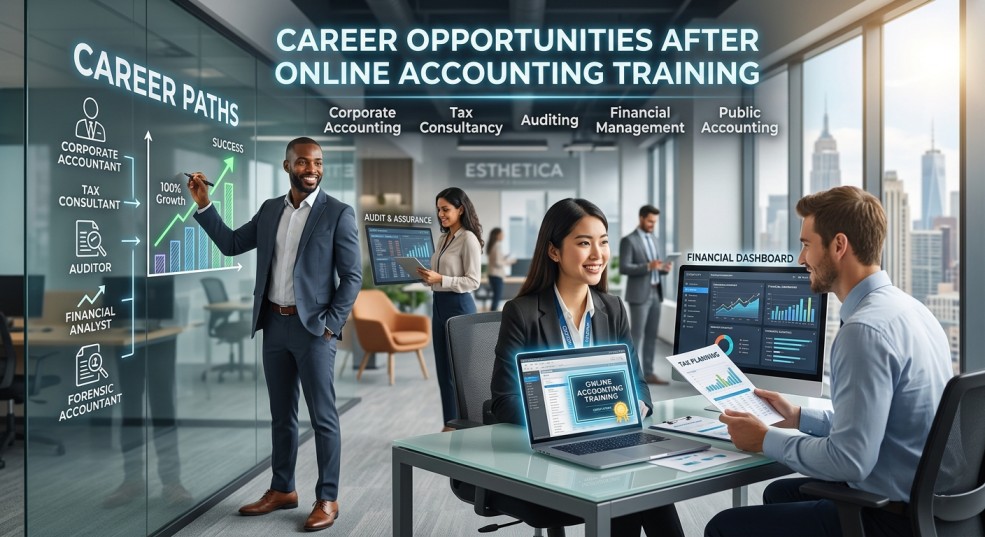
Completing a professional accounting course opens doors across virtually every industry sector. Because every enterprise—from tech startups to manufacturing conglomerates—requires financial tracking, statutory compliance, and tax management, skilled accounting professionals remain in high demand. If you are pursuing or have recently finished your training with Accounting Sikho, exploring the full spectrum of career opportunities after online accounting training will help you target high-growth job roles.
Modern online training programs bridge the gap between classroom theory and real-world execution. By mastering cloud ERP systems, tax filing portals, and data analytics, learners can quickly transition from entry-level positions to specialized financial management roles.
High-Demand Job Roles to Pursue
Completing structured online training prepares candidates for various specialized profiles based on their technical interests and software expertise.
1. General Accountant / Staff Accountant
Staff accountants maintain daily general ledgers, perform bank reconciliations, draft balance sheets, and prepare profit and loss statements.
- Core Responsibilities: Journal entry posting, monthly financial closing, ledger auditing, and inventory tracking.
- Key Tools: Tally Prime, Zoho Books, QuickBooks, MS Excel.
2. Tax Executive / GST Consultant
Taxation remains one of the most lucrative branches within corporate finance. Professionals specializing in direct and indirect taxation assist businesses in staying compliant with government regulations.
- Core Responsibilities: Preparing GST returns (GSTR-1, GSTR-3B), calculating TDS deductions, income tax return filing, and resolving tax reconciliation mismatches.
- Key Skills: Indian GST law, portal navigation, tax computation, statutory compliance.
3. Accounts Receivable / Payable Manager
Managing working capital is vital for cash flow health. Specialists in payable and receivable management oversee vendor invoices, client billing schedules, and credit monitoring.
- Core Responsibilities: Aging schedule analysis, vendor payments processing, invoice verification, and credit term enforcement.
- Key Skills: Reconciliation, vendor management, ERP invoice pipelines.
4. Payroll Analyst
Payroll specialists handle employee compensation, tax withholdings, social security deductions, and statutory reporting.
- Core Responsibilities: Computing monthly salaries, calculating Provident Fund (PF), Employee State Insurance (ESI), and Professional Tax deductions.
- Key Tools: Automated payroll software, Excel macros, HRMS integration.
5. Financial Analyst & Advisory Assistant
For learners with strong quantitative analytical skills, financial reporting opens pathways toward corporate strategy and financial planning.
- Core Responsibilities: Variance analysis, budgeting forecasts, financial ratio analysis, and executive dashboard reporting.
- Key Tools: Power BI, Advanced Excel (Pivot tables, XLOOKUP), financial modeling frameworks.
Core Skills Employers Look For
Completing a course is step one; proving practical execution to hiring managers is step two. To leverage maximum career opportunities after online accounting training, candidates should ensure their portfolio highlights practical competencies:
Skill Domain | Key Technologies & Concepts | Industry Application |
Cloud ERP & Software | Tally Prime, QuickBooks, Zoho Books, SAP FI | Managing digitized enterprise accounts |
Statutory Tax Compliance | GST, TDS, Income Tax, E-Way Bills | Ensuring penalty-free corporate filings |
Data Analytics | MS Excel (Advanced), Power BI, SQL | Transforming raw ledgers into visual dashboards |
Financial Reporting | Trial Balance, P&L, Balance Sheet, Cash Flow | Supporting executive strategy & audit review |
At Accounting Sikho, learning modules place direct emphasis on practical scenario solving—allowing students to showcase simulated real-world projects during job interviews.
Alternative Career Options: Freelancing & Remote Work
Traditional full-time corporate roles are not the only option available today. Online accounting skills translate directly into remote and flexible earning avenues:
- Freelance Bookkeeping: Many small business owners and regional merchants outsource their weekly and monthly ledger maintenance to independent accountants.
- GST & Tax Advisory Services: Certified tax practitioners often establish independent consultancies assisting local client bases with quarterly filings and registrations.
- Remote Global Accounting: International firms frequently outsource bookkeeping tasks to offshore candidates skilled in cloud-based platforms like QuickBooks Online and Xero.
How Accounting Sikho Prepares You for Career Advancement
Transitioning from learner to employed professional requires structured preparation. Accounting Sikho aligns its training ecosystem to support job readiness through:
- Practical Real-Data Training: Students practice on sample client datasets rather than memorizing dry textbook theory.
- Resume & Interview Coaching: Mentors guide candidates on highlighting software certifications, project portfolios, and relevant keyphrase terms on platforms like LinkedIn and Job Portals.
- Continuous Software Upgrades: Courses are continuously updated to reflect changes in tax legislation, software features, and compliance rules.
Frequently Asked Questions (FAQs)
1. What are the top career opportunities after online accounting training for freshers?
Freshers can start as Junior Accountants, Accounts Executive, Accounts Payable/Receivable Associates, or Tax Assistants. These entry-level positions offer clear pathways toward Senior Accountant and Finance Manager roles.
2. Is an online accounting certification recognized by employers?
Yes. Employers prioritize practical software competency, ledger management skills, and tax portal familiarity over traditional classroom attendance. Demonstrating hands-on skill with tools like Tally and Excel validates your training.
3. Can I work remotely after completing an online accounting course?
Absolutely. Cloud-based tools like Zoho Books and QuickBooks enable accountants to manage financial books, issue invoices, and file tax returns remotely for domestic or international clients.
4. How does Accounting Sikho assist in career preparation?
Accounting Sikho combines comprehensive theoretical fundamentals with practical tool mastery, portfolio guidance, and interview prep designed specifically for modern finance job roles.